It seems that pencils are always in high demand in my classroom. Where do they all go? I start the year with 18 pencils per student and sometimes by the end of April, I have none left.
I decided to do another Quick Challenge on this issue to see what my 4th graders could make of it. I had some ideas about what was happening to the pencils, but since I had learned so much about lunch from the last Quick Challenge, I didn't share any of my thoughts.
We started by partnering up and brainstorming together what some of the problems were. I stressed that they were only to think about the problems, not figure out solutions. Then we collected them all on the white board.
As you can see, they came up with quite a comprehensive list. Next, I asked them to choose one of the problems, or more if they thought they were connected, to come up with some solutions. I suggested they choose problems that interested them or that they thought would be fun to solve. The solutions were pretty straightforward. The erasers on the ends of the pencils get used up quickly, but they can use a separate eraser instead. Students could write their name or initials on their pencils. (I though this was a bit extreme, but several of them did this.) There were a few pencil hoarders in the class, who had more pencils in their desks than they could possibly use. One of them came up to me privately and asked if he could return some!
We didn't take this too seriously and had some fun with this problem. The activity reenforced the idea of taking time to examine the problem, and only after determining the cause(s) to move on to exploring solutions.
Tuesday, May 12, 2015
Sunday, May 3, 2015
Problem solving in Geography and History
Geography is another area that lends itself to including problem solving. There are many essential questions that elementary students can consider while they're learning basic ideas of geography.
In our 4th grade social studies we explore the early British colonists and Jamestown and Plymouth before moving on to later colonial times and the American Revolution. We look at exactly what the settlers at Plymouth were looking for in a site for their colony and what circumstances led them to pick Plymouth. Then we contrast that with the decisions that the settlers of Jamestown made about their location. Neither group made the ideal choice. The Pilgrims were very pressed to find something before the winter weather grew even worse. The Jamestown settlers were being directed long distance from England by investors who were mostly concerned with finding gold.
I had the idea that we could incorporate geography by having students use a map of the Plymouth area to decide on a settlement location. They knew that the Pilgrim were looking for a spot with a high hill for a lookout over the ocean, flat lands for growing crops, fresh water, a nearby forest for both hunting and lumber, and a deep enough harbor for ships. Students had to apply their knowledge of map scale in choosing a location, and note the lakes and streams in the area. The other three criteria, however, were not apparent on the map we used.
Then, I attended the the Colonial Williamsburg Teacher Institute and came home with so many wonderful teaching activities! One of them was a geography activity with a scenario set in 1630. It included all the concepts we wanted our students to deal with in their problem solving. They need to evaluate the conditions and connections of five possible settlement sites. The map is a made-up location. Each of the sites has advantages and disadvantages, so there is no correct or easy answer. Students have to think about what the settlers' goals in starting a settlement are, as well as what the site is like (conditions) and what is nearby (connections). This is the map from the activity:
We have the 4th graders work in small groups on this activity. There is always a lot of discussion. They are asked to rate each site for both positive and negative aspects, and to pick the locations with the best conditions, worst conditions, best connections, and worst connections before deciding upon the best site to build a fortified town in 1630.
I have not been able to find this activity on the Williamsburg teacher site, but I found two versions when I did a Google search. They are both a little different than the version I have, having been adapted for specific teaching situations. They can be found at Conditions and Connections Near Jamestown and Geography Activity: Conditions and Connections.
Another wonderful source for geography curriculum that requires problem solving is NASA. I will post about those activities later.
In our 4th grade social studies we explore the early British colonists and Jamestown and Plymouth before moving on to later colonial times and the American Revolution. We look at exactly what the settlers at Plymouth were looking for in a site for their colony and what circumstances led them to pick Plymouth. Then we contrast that with the decisions that the settlers of Jamestown made about their location. Neither group made the ideal choice. The Pilgrims were very pressed to find something before the winter weather grew even worse. The Jamestown settlers were being directed long distance from England by investors who were mostly concerned with finding gold.
I had the idea that we could incorporate geography by having students use a map of the Plymouth area to decide on a settlement location. They knew that the Pilgrim were looking for a spot with a high hill for a lookout over the ocean, flat lands for growing crops, fresh water, a nearby forest for both hunting and lumber, and a deep enough harbor for ships. Students had to apply their knowledge of map scale in choosing a location, and note the lakes and streams in the area. The other three criteria, however, were not apparent on the map we used.
Then, I attended the the Colonial Williamsburg Teacher Institute and came home with so many wonderful teaching activities! One of them was a geography activity with a scenario set in 1630. It included all the concepts we wanted our students to deal with in their problem solving. They need to evaluate the conditions and connections of five possible settlement sites. The map is a made-up location. Each of the sites has advantages and disadvantages, so there is no correct or easy answer. Students have to think about what the settlers' goals in starting a settlement are, as well as what the site is like (conditions) and what is nearby (connections). This is the map from the activity:
We have the 4th graders work in small groups on this activity. There is always a lot of discussion. They are asked to rate each site for both positive and negative aspects, and to pick the locations with the best conditions, worst conditions, best connections, and worst connections before deciding upon the best site to build a fortified town in 1630.
I have not been able to find this activity on the Williamsburg teacher site, but I found two versions when I did a Google search. They are both a little different than the version I have, having been adapted for specific teaching situations. They can be found at Conditions and Connections Near Jamestown and Geography Activity: Conditions and Connections.
Another wonderful source for geography curriculum that requires problem solving is NASA. I will post about those activities later.
Tuesday, April 21, 2015
makeschooldifferent
There's been a challenge traveling around Twitter recently with the hashtag #makeschooldifferent. The challenge is to list 5 things that begin with 'When it comes to education, we have to stop pretending..." There have been lots of responses with lists, covering lots of aspects of education today. As I read just some of the many thoughtful and thought-provoking lists, I thought about my own teaching, and of the frustrations many teachers face, and also my own children's experience in school. The challenge started with a post by Scott McLeod, which you can read here.
Here's my list:
We have to stop pretending ...
1. That covering the curriculum is the same thing as students learning skills and information.
2. The recess has no value.
3. That music and art are entertaining extras.
4. That a noisy classroom can't also be a productive learning environment.
5. That teachers are only teaching when they're giving direct instruction..
I teach at a wonderful independent school that serves gifted children from preschool through 8th grade. We have the freedom to try new things and we have been given many great tools to help us, especially in technology. Visitors to our school always comment on the positive energy and creativity they see. So my 5 things are not so much about my school as what I read about education generally. But we still struggle with the changes that are constantly happening - in technology, student populations, what is important to teach in the 21st century, how do we fit it all it ...
An educator who I respect very much recently said in conversation that we are in a tsunami of educational change that we are not yet aware of. One thing that is certain is that education be different.
Here's my list:
We have to stop pretending ...
1. That covering the curriculum is the same thing as students learning skills and information.
2. The recess has no value.
3. That music and art are entertaining extras.
4. That a noisy classroom can't also be a productive learning environment.
5. That teachers are only teaching when they're giving direct instruction..
I teach at a wonderful independent school that serves gifted children from preschool through 8th grade. We have the freedom to try new things and we have been given many great tools to help us, especially in technology. Visitors to our school always comment on the positive energy and creativity they see. So my 5 things are not so much about my school as what I read about education generally. But we still struggle with the changes that are constantly happening - in technology, student populations, what is important to teach in the 21st century, how do we fit it all it ...
An educator who I respect very much recently said in conversation that we are in a tsunami of educational change that we are not yet aware of. One thing that is certain is that education be different.
Tuesday, April 7, 2015
Houston, we are set for launch
When you're trying to add more problem solving opportunities to the curriculum, math is a natural area. A valuable source for math and science problem solving is Mission Mathematics, jointly published by the National Council of Teachers of Mathematics and NASA. The book is available at four different grade levels ranging from preschool through high school. It contains many activities that require students to apply their math knowledge to successfully complete investigations that incorporate aeronautics, astronomy, and other space-related subjects. I have used activities with both kindergartners and 3rd and 4th graders.
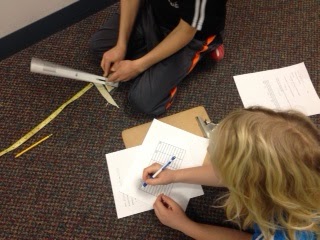
One of the investigations that my partner and I do every year is the Protractor Rocket Launches. Like the other activities in Mission Mathematics, this is a structured investigation. Students are presented with the question of what will happen when a rubber band is launched at three different angles, 30, 60 and 90 degrees. They are given instructions on how to construct a launcher using a protractor, ruler, and tape. Then they use this to collect data by launching multiple times at the three different angles. Students work in small groups throughout this activity, which is a valuable collaborative experience.
Over the years, I have tweaked and added to the original directions for the lesson. I have students write their predictions before beginning. Most of my students realize that a rubber band shot at a 90 degree angle will go straight up, but they don't always intuit from that that a 60 degree launch will not go as far as a 30 degree one. A 30 degree launch can go quite far - we go into the hallways for the launching part of this activity.
After the data is collected, we have students find the statistical landmarks, and then, thinking about what they learned from this experiment about angles of launch, they decide how best to graph the data. They have already spend a significant number of math classes on data and graphing, so at this point I stress to them that their goal is to communicate the big idea of this experiment, so how they choose to graph it must clearly show that big idea. I have had students try line graphs, bar graphs, line plots, and stem and leaf plots. Thankfully, no one has ever thought that a circle graph would work. Many 4th graders think they need to graph every single launch, while others realize that they can use the mean or median to communicate the important information. We use all of those choices to discuss what really is the big idea - that 30 degree launches go the furthest, 90 degrees goes the least far because it is going straight up, and 60 degrees is in the middle. Then we look at the variety of choices in graphing and think about which kind of graph best communicates this.
We also have students answer questions about whether one angle of launch is "best," or if there are appropriate uses for each angle. I also ask them to think about how they might improve the experiment or add onto it if they were going to launch more rubber bands. I have found that students often focus on other variables in the experiment that were not controlled for, such as how far everyone is pulling back the rubber band before letting it launch. These questions are often homework.
Altogether, this project takes us about 3 days.
This is a more structured experience than some of the open design thinking projects, but it requires thoughtful decision making, use of real collected data, and making connections to real life applications. It is also a productive break from the normal math lessons and an opportunity to use collaborative skills. Kids really enjoy this break from routine!
One of the investigations that my partner and I do every year is the Protractor Rocket Launches. Like the other activities in Mission Mathematics, this is a structured investigation. Students are presented with the question of what will happen when a rubber band is launched at three different angles, 30, 60 and 90 degrees. They are given instructions on how to construct a launcher using a protractor, ruler, and tape. Then they use this to collect data by launching multiple times at the three different angles. Students work in small groups throughout this activity, which is a valuable collaborative experience.
Over the years, I have tweaked and added to the original directions for the lesson. I have students write their predictions before beginning. Most of my students realize that a rubber band shot at a 90 degree angle will go straight up, but they don't always intuit from that that a 60 degree launch will not go as far as a 30 degree one. A 30 degree launch can go quite far - we go into the hallways for the launching part of this activity.
| Launching rubber bands and recording data |
After the data is collected, we have students find the statistical landmarks, and then, thinking about what they learned from this experiment about angles of launch, they decide how best to graph the data. They have already spend a significant number of math classes on data and graphing, so at this point I stress to them that their goal is to communicate the big idea of this experiment, so how they choose to graph it must clearly show that big idea. I have had students try line graphs, bar graphs, line plots, and stem and leaf plots. Thankfully, no one has ever thought that a circle graph would work. Many 4th graders think they need to graph every single launch, while others realize that they can use the mean or median to communicate the important information. We use all of those choices to discuss what really is the big idea - that 30 degree launches go the furthest, 90 degrees goes the least far because it is going straight up, and 60 degrees is in the middle. Then we look at the variety of choices in graphing and think about which kind of graph best communicates this.
We also have students answer questions about whether one angle of launch is "best," or if there are appropriate uses for each angle. I also ask them to think about how they might improve the experiment or add onto it if they were going to launch more rubber bands. I have found that students often focus on other variables in the experiment that were not controlled for, such as how far everyone is pulling back the rubber band before letting it launch. These questions are often homework.
Altogether, this project takes us about 3 days.
This is a more structured experience than some of the open design thinking projects, but it requires thoughtful decision making, use of real collected data, and making connections to real life applications. It is also a productive break from the normal math lessons and an opportunity to use collaborative skills. Kids really enjoy this break from routine!
Thursday, March 26, 2015
The Three Bears' Problem, and Solutions
A problem with trying to add problem solving and design thinking to the curriculum is finding time to fit it in. One partial solution is to integrate creative problem solving and thinking skills into other subjects. One of the activities my class did this year that integrated language arts with creative problem solving was the Goldilocks problem. This activity originated in the book From the Land of Enchantment, by Jerry Flack.
I started this lesson by reading two different version of "Goldilocks and the Three Bears," one by Jan Brett and the other by James Marshall. Jan Brett's version is very traditional and beautifully illustrated. Many of my students are not familiar with traditional versions of European fairy tales, having either only seen the Disney versions or they are from another culture. Brett's version gives them the basic story and a lush image. James Marshall's Goldilocks has quite a personality. Marshall tells the basic story with humor and more cartoon-like illustrations. So after reading both, my students have the traditional tale in their minds, along with some possible personality traits that may be helpful as they move into problem solving.
Next we brainstormed the problems that are left at the end of the story. After some discussion, the class agreed that it's the Bears who still have problems. What if Goldilocks comes back? It's not pleasant to have a little girl break into your house and ruin your belongings.
Working in small groups, students generated ideas that the Bear family might try to solve this problem. I warned them that no one, including Goldilocks, could be hurt by their solutions. After each group had several possible solutions, the next step was to choose one solution and create an action plan. I gave them a Who-What-Where-Why-How worksheet to help them focus their ideas.
Jerry Flack includes many helpful ideas for teachers in working through the steps of Creative Problem Solving, and he also includes examples of possible problems, solutions, and action plans. The lesson plan is very adaptable to different focuses and to different age groups. The book seems to be out of print at this time, but it is not difficult to find used copies online.
Most of my students focused on ways to keep Goldilocks from getting into the Bears' house a second time. Alarms, moats, and peep holes were some of the solutions. Interestingly, none of them suggested locking the door! One group of students chose helping Goldilocks have better manners and respect as their goal. They planned to invite Goldilocks to the Bears' house for a friendly discussion. All the ideas were shared with the whole class. I hope this helped them all to see that there are many solutions to the same problem.
The last part of the Goldilocks activity was another version of the fairy tale. This one is Goldilocks and the Three Hares, by Heidi Petach. This version has rabbits instead of bears and it really funny. The Rabbit family is quite modern - Mama burns the oatmeal, so the family goes out for breakfast. Goldilocks falls into their rabbit hole and very entertainingly goes through the porridge, chairs, and beds parts of the story (Papa Rabbit has a water bed, causing a different sort of problem for this Goldilocks. Running along the bottom of each page is another story featuring a family of mice, who sarcastically comment on the story going on above them. I would read this just because it's so funny, creative and well executed with story of illustrations. But it can also show children that problems can be approached for other directions entirely.
That is where we left Goldilocks, though there are plenty of other related activities, including writing sequels, telling the story from another perspective, or putting Goldilocks on trial, to name a few. My goal with this lesson was to try to push my students to think divergently and then convergently, so that they would think outside the box of the fairy tale, but also follow the problem through to a solution.
Next we brainstormed the problems that are left at the end of the story. After some discussion, the class agreed that it's the Bears who still have problems. What if Goldilocks comes back? It's not pleasant to have a little girl break into your house and ruin your belongings.
Working in small groups, students generated ideas that the Bear family might try to solve this problem. I warned them that no one, including Goldilocks, could be hurt by their solutions. After each group had several possible solutions, the next step was to choose one solution and create an action plan. I gave them a Who-What-Where-Why-How worksheet to help them focus their ideas.
Jerry Flack includes many helpful ideas for teachers in working through the steps of Creative Problem Solving, and he also includes examples of possible problems, solutions, and action plans. The lesson plan is very adaptable to different focuses and to different age groups. The book seems to be out of print at this time, but it is not difficult to find used copies online.
Most of my students focused on ways to keep Goldilocks from getting into the Bears' house a second time. Alarms, moats, and peep holes were some of the solutions. Interestingly, none of them suggested locking the door! One group of students chose helping Goldilocks have better manners and respect as their goal. They planned to invite Goldilocks to the Bears' house for a friendly discussion. All the ideas were shared with the whole class. I hope this helped them all to see that there are many solutions to the same problem.
The last part of the Goldilocks activity was another version of the fairy tale. This one is Goldilocks and the Three Hares, by Heidi Petach. This version has rabbits instead of bears and it really funny. The Rabbit family is quite modern - Mama burns the oatmeal, so the family goes out for breakfast. Goldilocks falls into their rabbit hole and very entertainingly goes through the porridge, chairs, and beds parts of the story (Papa Rabbit has a water bed, causing a different sort of problem for this Goldilocks. Running along the bottom of each page is another story featuring a family of mice, who sarcastically comment on the story going on above them. I would read this just because it's so funny, creative and well executed with story of illustrations. But it can also show children that problems can be approached for other directions entirely.
That is where we left Goldilocks, though there are plenty of other related activities, including writing sequels, telling the story from another perspective, or putting Goldilocks on trial, to name a few. My goal with this lesson was to try to push my students to think divergently and then convergently, so that they would think outside the box of the fairy tale, but also follow the problem through to a solution.
Thursday, January 29, 2015
The Quick Challenge
How might lunch at school be improved/more fun/different?
This was the quick challenge my class recently tackled. The idea of quick challenges comes from the book Creative Confidence by Tom and David Kelley, discussed in several earlier posts. In a quick challenge, small groups are given a situation, such as redesigning gift-giving or wallets, to practice the skills of design thinking. The purposes of this type of exercise are to build confidence and to learn from failures in a safe situation. I chose to have my students consider lunch at school, since it is an easy thing for them to observe and think about.
I first assigned students to observe at lunch and come up with one thing each really liked about lunch at school and one thing he/she did not like, thought could be improved, or could be different. The discussed their ideas in small groups, making connections between ideas and piggybacking onto others' ideas. Then we collected an assortment of lunch-related characteristics that one or more students thought would benefit from a change.
This was the quick challenge my class recently tackled. The idea of quick challenges comes from the book Creative Confidence by Tom and David Kelley, discussed in several earlier posts. In a quick challenge, small groups are given a situation, such as redesigning gift-giving or wallets, to practice the skills of design thinking. The purposes of this type of exercise are to build confidence and to learn from failures in a safe situation. I chose to have my students consider lunch at school, since it is an easy thing for them to observe and think about.
I first assigned students to observe at lunch and come up with one thing each really liked about lunch at school and one thing he/she did not like, thought could be improved, or could be different. The discussed their ideas in small groups, making connections between ideas and piggybacking onto others' ideas. Then we collected an assortment of lunch-related characteristics that one or more students thought would benefit from a change.
As shown by the list, there were no wild and crazy ideas, but I hope there will be in the future as the 4th graders get more comfortable with the process. All of the ideas were relevant to lunch, if not practical. As our whole class discussion progressed, themes began to emerge, and we then focused on the desire for more time for lunch. I asked why they wanted more time and the unanimous response was that they felt they didn't have enough time to eat. We have 20-minute lunch periods, which seem adequate to the adults in the school. One student commented, "But we can't change the schedule, can we?" I agreed that neither they or I could change the schedule, but we could think about the problem they identified - not enough time to eat - and look for other solutions to that. They were able to conclude that we could include additional snack times during classroom times.
After this breakthrough, they started looking at the list with an eye to finding the things that students might have some control over. One student said, "We could bring our own chocolate mix to make chocolate milk." Other ideas were asking the adult supervisors to help with shouting in the lunchroom and bringing their own bigger desserts from home.
We will be repeating this exercise with other scenarios. For now we have made a start in helping students realize that they can find problems on their own to try to solve, which they will be asked to do later in STEAM classes, and it’s important to ask why something is a problem, because that may lead you to possible solutions.
Saturday, December 6, 2014
Design Thinking: Taking the First Steps
Sliding under my daughter's bed in search of her collection of beanie babies is a most unusual part of lesson preparation, even for an elementary teacher. But, I needed a number of stuffed animals for a creative problem solving lesson and I thought the beanie babies would fit the bill nicely. We'll return to them in a moment.
I began my integration of creative and design thinking into my 4th grade curriculum with the book Creative Confidence, which I wrote about back in August. I realized, though, that I would have to begin by laying a foundation for my students that would include brainstorming experience, productive collaborative work, listening skills, and a variety of practice scenarios before we could use many of the ideas from the book. I have some experience using Creative Problem Solving (CPS) in teaching, so I turned to one of the books I have, Big Tools for Young Thinkers by Susan Keller-Mathers and Kristin Puccio. CPS is a method that advocates a step by step process to encourage creative solutions. Both CPS and design thinking emphasize identifying a problem to solve, generating lots of ideas, suspending any judgment on the value of ideas, collaboration and divergent thinking, so I felt that CPS activities would be a productive first step..
The first sessions with my class were from Big Tools for Young Thinkers and introduced the rules of brainstorming, which they then applied in an activity generating ideas for preventing a squirrel from stealing all the fruit from your fruit tree. The students worked in small groups with the goals of coming up with as many ideas as possible and not criticizing anyone else's ideas during brainstorming. (They were also not allowed to harm the squirrel as part of a solution.) The next lesson we did from the book was machine creation through a drawing activity. For this exploration students drew ideas for three new machines, then switched papers with a partner. With someone else's ideas in front of them and their own in their heads, students tried piggybacking off their partner's machines to create different new creations. Our third CPS exercise was creating a new type of transportation by forcing a relationship between two different modes of transport. As can be seen, these activities are also a lot of fun.
I switched gears for the next lesson and took an idea I had gotten from Search Inside Yourself: The Unexpected Path to Success, Happiness (and World Peace) by Chade-Ming Tan. This is a wonderful book on mindfulness. One of the exercises in the book is a listening exercise in which partners take turns listening and talking. The speaker has three minutes to speak, uninterrupted, about any one topic. The topic should be a serious one that is important to the speaker, such as a time when you were upset or sad. The listener's job is to listen, look at the speaker's face, nod encouragingly, and possibly say, "mm hmm," but nothing more. If the speaker runs out of things to say, the two sit in silence until either the speaker says something or the three minutes are up. Then they switch roles. Though I got this from Search Inside Yourself, one of the drama teachers at Quest told me this comes from drama education. I chose to do this activity because one of the aspects of the design thinking process is really listening to others (often customers in the business and engineering worlds) in order to understand the problems that you might be trying to solve. I wanted to apply this to some of the problems I would present to my class during the year.
For my 4th graders, talking is not very difficult, but staying silent and focused on the speaker was a huge step. I was thrilled at how well they carried this out. With debriefed afterwards about how they felt as speaker and as listener. Most of them found both roles challenging.
The next lesson called on listening skills, as well as brainstorming. This exercise asked students to take two stuffed animals and create a new animal through the forced relationship. This is the reason I was under my daughter's bed, searching for beanie babies. She had collected a lot at the height of the Beanie Baby craze, and they are smaller than many stuffed animals, making it easy for me to bring a lot of them to school. Each student got two diverse animals and drew a new stuffed animal, with a description or name. Taking this activity a step further, I had partners interview each other, using their listening skills, about what characteristics each wanted in a stuffed animal. Then they created animals for each other, again drawing them on paper, and presented them to the class.
All of the above activities were done in our first trimester. One of the challenges in adding Creative Thinking to my curriculum was finding time for it. I spend between 30 and 60 minutes on it per week, though some weeks special events take over that time. I have a long Thursday afternoon with my students, so these types of lessons, that are more interactive, are perfect for keeping focus and engagement.
In the second trimester we will be moving into some different types of creative explorations. I am planning ways to integrate creative thinking and problem solving lessons into other subjects, especially now that me students have some of the basics of the process down. We are in the alpha stage of development - an exciting process!
I began my integration of creative and design thinking into my 4th grade curriculum with the book Creative Confidence, which I wrote about back in August. I realized, though, that I would have to begin by laying a foundation for my students that would include brainstorming experience, productive collaborative work, listening skills, and a variety of practice scenarios before we could use many of the ideas from the book. I have some experience using Creative Problem Solving (CPS) in teaching, so I turned to one of the books I have, Big Tools for Young Thinkers by Susan Keller-Mathers and Kristin Puccio. CPS is a method that advocates a step by step process to encourage creative solutions. Both CPS and design thinking emphasize identifying a problem to solve, generating lots of ideas, suspending any judgment on the value of ideas, collaboration and divergent thinking, so I felt that CPS activities would be a productive first step..
The first sessions with my class were from Big Tools for Young Thinkers and introduced the rules of brainstorming, which they then applied in an activity generating ideas for preventing a squirrel from stealing all the fruit from your fruit tree. The students worked in small groups with the goals of coming up with as many ideas as possible and not criticizing anyone else's ideas during brainstorming. (They were also not allowed to harm the squirrel as part of a solution.) The next lesson we did from the book was machine creation through a drawing activity. For this exploration students drew ideas for three new machines, then switched papers with a partner. With someone else's ideas in front of them and their own in their heads, students tried piggybacking off their partner's machines to create different new creations. Our third CPS exercise was creating a new type of transportation by forcing a relationship between two different modes of transport. As can be seen, these activities are also a lot of fun.
I switched gears for the next lesson and took an idea I had gotten from Search Inside Yourself: The Unexpected Path to Success, Happiness (and World Peace) by Chade-Ming Tan. This is a wonderful book on mindfulness. One of the exercises in the book is a listening exercise in which partners take turns listening and talking. The speaker has three minutes to speak, uninterrupted, about any one topic. The topic should be a serious one that is important to the speaker, such as a time when you were upset or sad. The listener's job is to listen, look at the speaker's face, nod encouragingly, and possibly say, "mm hmm," but nothing more. If the speaker runs out of things to say, the two sit in silence until either the speaker says something or the three minutes are up. Then they switch roles. Though I got this from Search Inside Yourself, one of the drama teachers at Quest told me this comes from drama education. I chose to do this activity because one of the aspects of the design thinking process is really listening to others (often customers in the business and engineering worlds) in order to understand the problems that you might be trying to solve. I wanted to apply this to some of the problems I would present to my class during the year.
For my 4th graders, talking is not very difficult, but staying silent and focused on the speaker was a huge step. I was thrilled at how well they carried this out. With debriefed afterwards about how they felt as speaker and as listener. Most of them found both roles challenging.
![]() |
| One of the stuffed animals created after interviewing a partner |
The next lesson called on listening skills, as well as brainstorming. This exercise asked students to take two stuffed animals and create a new animal through the forced relationship. This is the reason I was under my daughter's bed, searching for beanie babies. She had collected a lot at the height of the Beanie Baby craze, and they are smaller than many stuffed animals, making it easy for me to bring a lot of them to school. Each student got two diverse animals and drew a new stuffed animal, with a description or name. Taking this activity a step further, I had partners interview each other, using their listening skills, about what characteristics each wanted in a stuffed animal. Then they created animals for each other, again drawing them on paper, and presented them to the class.
All of the above activities were done in our first trimester. One of the challenges in adding Creative Thinking to my curriculum was finding time for it. I spend between 30 and 60 minutes on it per week, though some weeks special events take over that time. I have a long Thursday afternoon with my students, so these types of lessons, that are more interactive, are perfect for keeping focus and engagement.
In the second trimester we will be moving into some different types of creative explorations. I am planning ways to integrate creative thinking and problem solving lessons into other subjects, especially now that me students have some of the basics of the process down. We are in the alpha stage of development - an exciting process!
Subscribe to:
Posts (Atom)